
Choosing the right e-commerce platform can make or break your online business. With over 12 years of experience building e-commerce solutions, we’ve helped countless businesses navigate this crucial decision. Today, we’re breaking down the two most popular platforms—Shopify and WooCommerce—to help you make an informed choice for your business.
The Quick Overview
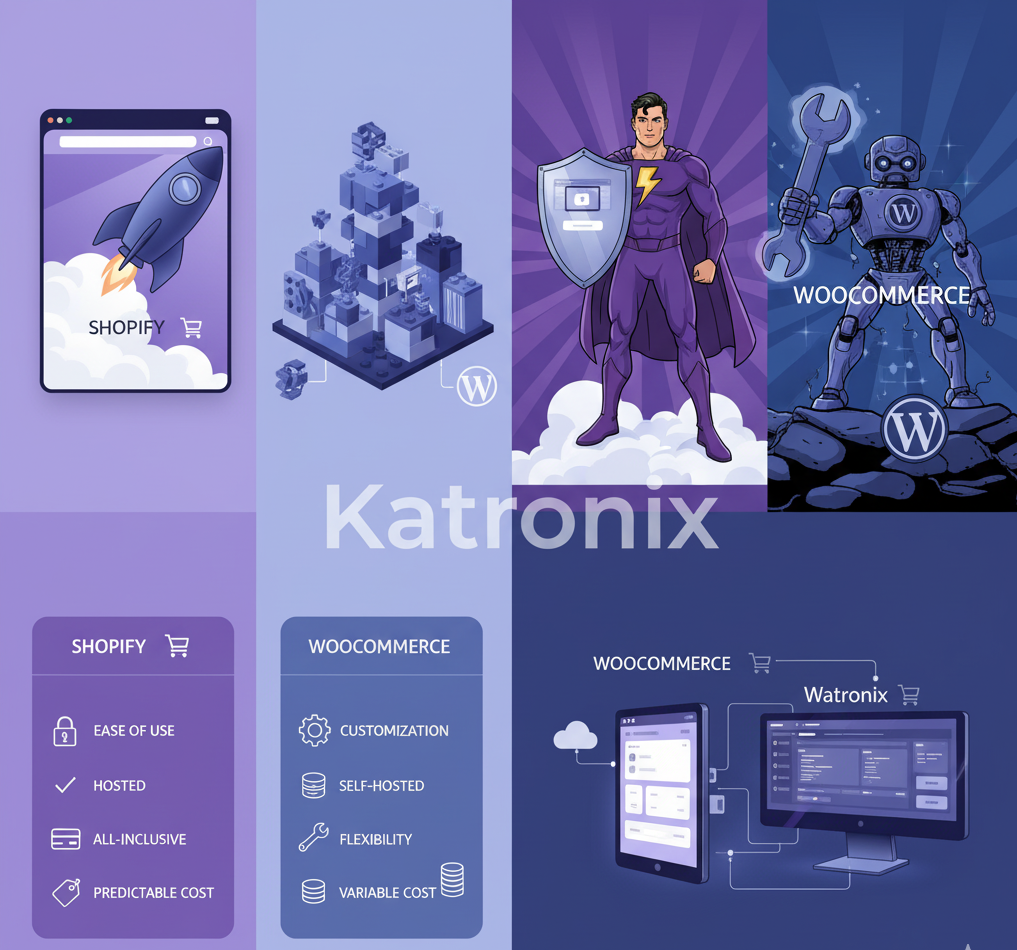
Shopify is an all-in-one hosted platform that handles everything from hosting to security, perfect for businesses wanting a plug-and-play solution.
WooCommerce is a flexible WordPress plugin that gives you complete control over your store, ideal for businesses seeking maximum customization and ownership.
Pricing Comparison
Shopify Pricing
- Basic Plan: $39/month
- Shopify Plan: $105/month
- Advanced Plan: $399/month
- Transaction Fees: 2.9% + 30¢ per transaction (or 0.5-2% if not using Shopify Payments)
WooCommerce Pricing
- Plugin: Free
- Hosting: $10-$100+/month (depending on your provider)
- Domain: $10-$15/year
- SSL Certificate: Often free with hosting
- Extensions: $0-$299+ (one-time or annual fees)
- Payment Processing: Varies by gateway (typically 2.9% + 30¢)
Winner: WooCommerce for budget-conscious startups; Shopify for predictable monthly costs.
Ease of Use
Shopify
Shopify wins on simplicity. You can launch a professional store in hours without any technical knowledge. The interface is intuitive, with drag-and-drop functionality and guided setup. Perfect for non-technical entrepreneurs who want to focus on selling rather than managing technology.
WooCommerce
WooCommerce requires some WordPress familiarity. While not overly complex, you’ll need to manage hosting, updates, backups, and security yourself. The learning curve is steeper, but modern hosting providers and page builders have made it much more accessible.
Winner: Shopify for beginners; WooCommerce for those comfortable with WordPress.
Customization & Flexibility
Shopify
Shopify offers thousands of apps and themes, but customization has limits. Advanced modifications require knowledge of Shopify’s proprietary Liquid templating language. You’re working within Shopify’s ecosystem, which can be restrictive for unique business requirements.
WooCommerce
WooCommerce is built on WordPress, giving you virtually unlimited customization options. Access to thousands of plugins, complete code control, and the ability to modify every aspect of your store. If you can dream it, WooCommerce can likely do it.
Winner: WooCommerce for customization and flexibility.
Scalability
Shopify
Shopify handles all technical scaling automatically. As your traffic grows, Shopify’s infrastructure adapts without any action on your part. Perfect for businesses experiencing rapid growth who don’t want to worry about server capacity or performance optimization.
WooCommerce
Scaling WooCommerce requires planning. You’ll need to upgrade hosting as you grow and optimize for performance. However, this also means you have complete control over your scaling strategy and can choose specialized hosting solutions for e-commerce.
Winner: Shopify for hands-off scaling; WooCommerce for controlled, cost-effective growth.
Payment Options
Shopify
Shopify Payments is seamless, but using third-party gateways incurs additional transaction fees (0.5-2%). This can significantly impact profit margins for high-volume stores.
WooCommerce
WooCommerce supports virtually any payment gateway without additional platform fees. You only pay the gateway’s processing fees, giving you more flexibility and potentially lower costs.
Winner: WooCommerce for payment flexibility and lower fees.
SEO Capabilities
Shopify
Shopify provides solid basic SEO features but has limitations. URL structure is less flexible, and some technical SEO aspects are restricted. Recent improvements have closed the gap, but constraints remain.
WooCommerce
Built on WordPress, WooCommerce benefits from the world’s most SEO-friendly CMS. Complete control over URLs, metadata, schema markup, and access to powerful SEO plugins like Yoast and RankMath.
Winner: WooCommerce for advanced SEO control.
Security & Maintenance
Shopify
Security, updates, backups, and maintenance are all handled by Shopify. You never worry about patches, vulnerabilities, or server management. This peace of mind comes at the cost of monthly fees.
WooCommerce
You’re responsible for security, updates, and maintenance. While this adds responsibility, quality hosting providers offer managed WordPress solutions that handle much of this automatically.
Winner: Shopify for hands-off security; WooCommerce with managed hosting for balance.
Mobile Commerce
Both platforms offer excellent mobile responsiveness and mobile shopping experiences. Shopify has a slight edge with its native mobile app for store management, though WooCommerce also offers mobile management through WordPress apps.
Winner: Tie, with a slight edge to Shopify for store management.
Support & Community
Shopify
24/7 customer support via chat, email, and phone. Extensive documentation and active community forums. Professional support is part of your monthly subscription.
WooCommerce
Community-based support through forums, with paid support available for specific extensions. The massive WordPress community means solutions to most problems are readily available through tutorials and forums.
Winner: Shopify for direct support; WooCommerce for community resources.
Which Platform is Right for You?
Choose Shopify if you:
- Want a quick, hassle-free setup
- Prefer all-in-one solutions with minimal technical management
- Need reliable hosting and security handled automatically
- Plan to scale rapidly without technical overhead
- Value 24/7 professional support
- Don’t need extensive customization
Choose WooCommerce if you:
- Want complete control over your store
- Are comfortable with WordPress or have technical support
- Need extensive customization for unique business needs
- Want to avoid transaction fees
- Require advanced SEO capabilities
- Prefer to own your platform rather than rent it
- Have specific integration requirements
Our Recommendation at Katronix Technologies
After helping businesses launch hundreds of e-commerce stores, here’s our honest assessment:
For small to medium businesses just starting out: Shopify offers the fastest path to market with minimal technical risk. You can always migrate later if you outgrow the platform.
For businesses with specific requirements or existing WordPress sites: WooCommerce provides the flexibility and control you need. With our managed development and support, the technical overhead becomes much more manageable.
Ultimately, the best choice depends on your business’s needs, technical skills, and long-term goals. Both platforms are highly capable and will help you build a successful online store, but they shine in different areas.
Need help deciding? Contact us at Katronix Technologies, and we’ll help you choose the right platform for your business!
Leave a Reply